The Supreme Court of India has cautioned against the dangers of unregulated social media, emphasizing that freedom of speech cannot be exercised at the expense of others' dignity and integrity. The court was addressing a plea related to a recent incident where a shoe was thrown at the Chief Justice of India.

The Supreme Court has directed the Maharashtra government and its state election commission to conduct local body elections, clarifying that the results will be subject to the court's final verdict, especially concerning the 50% quota limit. The court will hear pleas regarding OBC reservation in local bodies in January 2026.

The Supreme Court is considering relaxing the ban on firecrackers in Delhi-NCR ahead of Diwali, citing practical concerns and the need to balance environmental and livelihood interests.

The Supreme Court is examining the extent to which courts can intervene when governors delay or refuse to act on bills passed by state assemblies. The court questioned the Centre on whether judicial review is barred in cases of gubernatorial inaction, sparking debate on the balance of power between states and the central government.

The Supreme Court of India has questioned the legal status of Rohingya refugees living in the country, raising concerns about providing resources to illegal entrants while Indian citizens face poverty.
The Supreme Court has questioned the central government about the possibility of constructing a border wall to prevent illegal immigration, drawing parallels with the US border policy. The court also addressed concerns about the detention and deportation of Bengali-speaking migrant workers.

The Supreme Court declined to initiate contempt action against a lawyer who hurled a shoe at the Chief Justice of India, citing the CJI's own refusal to proceed against him. The court is considering guidelines to prevent such incidents.

The Supreme Court refused to stay a provision barring the declaration of tribal lands as waqf properties, upholding key provisions of the Amended Waqf Act.

The ED has accused Congress leaders Sonia Gandhi and Rahul Gandhi, as well as late party leaders Motilal Vora and Oscar Fernandes, along with Suman Dubey, Sam Pitroda, and a private company, Young Indian, of conspiracy and money laundering.

The Supreme Court has directed the CBI to conduct a pan-India investigation into digital arrest scams and questioned the RBI about its lack of AI usage in detecting and freezing accounts used by cybercriminals.
A lawyer for Elon Musk's X told the Karnataka high court on Tuesday that if every "Tom, Dick and Harry" government official is authorised to send content takedown notices then it would amount to misuse of official powers, remarks that drew strong condemnation from the Centre as well as the judge.

The Supreme Court has sought responses from the Centre and Union Territory of Ladakh regarding the detention of climate activist Sonam Wangchuk under the National Security Act. Wangchuk's wife filed a plea seeking his release. The court has scheduled the next hearing for October 14.
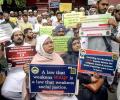
A bench comprising Chief Justice B R Gavai and Justice Augustine George Masih asked senior advocate Kapil Sibal, appearing for those challenging the validity of the law, and Solicitor General Tushar Mehta, representing the Centre, to file their written notes by Monday.

Chief Justice of India Bhushan Ramkrishna Gavai retired, reflecting on his career, commitment to the Constitution, and social justice.

The Supreme Court has permitted the sale and bursting of green crackers in Delhi-NCR for Diwali, relaxing the ban on green firecrackers as a temporary measure from October 18 to 21. The court has asked pollution control boards to monitor pollution levels and file reports. The order also includes measures to prevent the sale of non-compliant crackers.

The Supreme Court of India has dismissed a plea against the construction of a new passenger jetty and terminal at the Gateway of India in Mumbai, upholding a Bombay High Court verdict that allowed the project to proceed. The project aims to improve passenger travel between South Mumbai and other locations.
The Supreme Court is reviewing objections to the movie 'Udaipur Files - Kanhaiya Lal Tailor Murder,' with the Centre suggesting six cuts. The court has extended a stay on the film's release until further orders.

The Indian government defended its decision to revoke the security clearance of Turkey-based Celebi without warning, citing an "unprecedented" threat to aviation security. Solicitor General Tushar Mehta argued that giving a hearing or reasons before taking action would "defeat the purpose" in matters of national security. The decision came after Turkey backed Pakistan and condemned India's airstrikes on terror camps in the neighboring country. Celebi, which operates at nine Indian airports, has challenged the government's move in court.
The Supreme Court has ruled that a Governor cannot send bills to the President for consideration if the state assembly has already cleared them for a second time. The court was questioning the Centre over the powers of the Governor when it comes to granting assent to bills.

The Supreme Court has stayed the Bombay High Court verdict acquitting all 12 accused in the 2006 Mumbai train bomb blasts case, issuing notices and seeking responses from the accused.
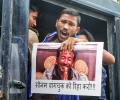
The Supreme Court has sought responses from the Centre and the Ladakh administration regarding the detention of climate activist Sonam Wangchuk under the National Security Act (NSA). Wangchuk's wife has filed a plea challenging the detention, claiming it violates his fundamental rights. The court has given the Centre and Ladakh administration 10 days to respond and has scheduled the next hearing for November 24.

The Supreme Court expressed serious concern over the Enforcement Directorate summoning advocates for offering legal advice or representing clients during investigations, calling for guidelines on the matter.

On Thursday, MMRDA strongly defended its decision to disqualify L&T from the two infrastructure projects in Mumbai, citing "substantial grounds" for the rejection of its technical bids.

The SC has sought a response from the Centre on a plea seeking the restoration of statehood to Jammu and Kashmir.

Adhikari, leader of the opposition in the West Bengal assembly, denied the charge, saying that he had recently gone to Mehta's residence in Delhi regarding a case related to "post-poll violence" in the state but "could not meet him in person".

Outgoing Supreme Court Justice Sudhanshu Dhulia bids farewell, expressing his deep connection to the legal community and the country.

A two-judge bench of the top court had on August 11 directed authorities in Delhi-National Capital Region (NCR) to start picking up stray dogs from all localities "at the earliest" and relocate the animals to dog shelters.
The Centre has told the Supreme Court that imposing fixed timelines on governors and the president to act on bills passed by a state Assembly would amount to one organ of the government assuming powers not vested in it by the Constitution and lead to a "constitutional disorder".

The Centre has opposed the imposition of fixed timelines on governors and the President for decisions on bills passed by state legislatures, arguing that such constraints were intentionally omitted by the Constitution's framers.
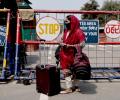
The Supreme Court on Friday directed authorities not to deport to Pakistan six members of a family, who allegedly overstayed their visa, till their citizenship claim is verified.

With the rise of digital classrooms, students are often asked to create videos, prepare slideshows or use online research to complete assignments. 'We are glad that children are not spending hours copying notes in the name of homework but even now parents end up doing or supporting a major portion of the homework.'

As soon as one of the pleas came up for hearing on Friday, Solicitor General Tushar Mehta, appearing for the Centre, objected and said there can't be an "endless" filing of pleas challenging the Act.
The Supreme Court has questioned the practice of Governors withholding assent to bills indefinitely, stating that it renders the constitutional provision of 'as soon as possible' meaningless.
The Indian government defended the Waqf (Amendment) Act, 2025 in the Supreme Court, arguing that waqf, while an Islamic concept, is not an essential part of Islam. Solicitor General Tushar Mehta stated that waqf is essentially charity, which is recognized across religions, and cannot be considered a fundamental tenet of any faith. He also argued that the amended law addresses secular aspects of waqf and activities unrelated to Islam, and that "waqf by user" does not grant ownership of public land. Mehta highlighted the extensive consultations involved in the bill's creation, including feedback from various stakeholders. The hearing will continue on Thursday.

The Supreme Court has directed the Delhi government and civic bodies to address the 'extremely grim' stray dog menace by picking up strays and housing them in shelters for sterilization and immunization. The court also warned against obstructing authorities and ordered the creation of a helpline for reporting dog bite cases.
BJP-ruled states argued in the Supreme Court that governors and the President have autonomy in assenting to bills passed by state assemblies, asserting that courts cannot mandate assent.

The Supreme Court has upheld the deletion of the 'waqf by user' provision in the amended waqf law, stating it is not arbitrary and addresses potential misuse.

"Liberty is granted to newly-added respondents (states) to file a response within 15 days from the date of service, and rejoinder if any be filed after 15 days. The interim order to continue and will equally apply to the cases mentioned in the amended writ petition. We direct no further cases be registered without the permission of this court," the bench's order said.
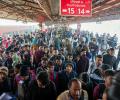
The Delhi high court on Wednesday asked the Railways to examine the fixing of maximum passengers and sale of platform tickets -- issues raised in a public interest litigation (PIL) over the recent stampede at the New Delhi Railway Station.
The Supreme Court of India has reserved its interim orders on three key issues related to the Waqf (Amendment) Act, 2025, including the power to denotify waqf properties, the composition of waqf boards, and the provision regarding government land. The court heard arguments from both the petitioners, who challenged the validity of the amended law, and the Centre, which defended the Act as a secular concept. The petitioners sought interim orders to prevent the implementation of certain provisions while the court considers the legal challenges.
